You should be able to understand what you are paying for, why that work matters and what happens next. You do not need to become an SEO specialist to ask those questions.
Monthly SEO can involve research, technical repairs, content, business information and measurement. The right mix depends on the website and the business. A fixed number of articles or a colourful ranking report does not tell you whether the work is useful.
There should be a reason for the month’s priorities
Ask the person doing the work to connect each major task with an identified need. “Improve the boiler installation page because it receives relevant impressions but does not explain the installation process” is easier to assess than “optimise content”.
Early work may involve fixing basic problems and establishing reliable measurements. Later work might focus on particular services, locations or unanswered customer questions. The same checklist repeated indefinitely deserves an explanation.
A sensible plan also acknowledges your capacity. There is little value in pushing a service you cannot currently deliver while ignoring one you want to grow.
Useful work can take several forms
Investigating and repairing technical problems
This might include pages that cannot be indexed, broken internal links or problems introduced by a site change. Ask which pages were affected, what was changed and how the fix was checked. An automated audit identifies possible issues; it is not evidence that every warning deserves paid work.
Improving the information customers find
Content work can mean revising a service page, answering a missing question, improving a title or consolidating repetitive pages. Ask what the intended reader needs to do afterwards. Article quantity is a poor substitute for that purpose.
Strengthening local information and credible references
For an eligible local business, this could involve keeping its profile accurate or resolving inconsistent information. Work involving links or third-party mentions should have a clear rationale and a transparent record of placements.
Google’s link spam policy is a useful reference when assessing schemes that promise ranking gains through paid or artificial links. Ask how a proposed activity complies with that policy before it is undertaken.
A report should distinguish activity from results
“We updated three pages” describes output. “More relevant searches are reaching those pages” describes a possible early result. “Those visits produced suitable enquiries” describes a business outcome. All can be useful, but they are not interchangeable.
I would expect a concise report to cover the work completed, evidence of change, limits of that evidence and the next decision. It should also identify unfinished work and anything needed from you.
For search reporting, agree the country, device, date range and pages being compared. Separate brand searches from searches for a service where possible. A change in the mix can make an average look better without improving the part of the business you care about.
How long should progress take?
There is no honest universal deadline for rankings or enquiries. Competition, the starting website, the work undertaken and the way customers buy all matter.
Uncertainty about results should not mean uncertainty about delivery. You can still agree when a review will be completed, which pages will be revised and when the next discussion happens. If outcomes are slow, the response should be an explanation and a considered next step.
One quiet month is not proof that SEO has failed. Equally, “SEO takes time” should not prevent questions about months of unclear activity.
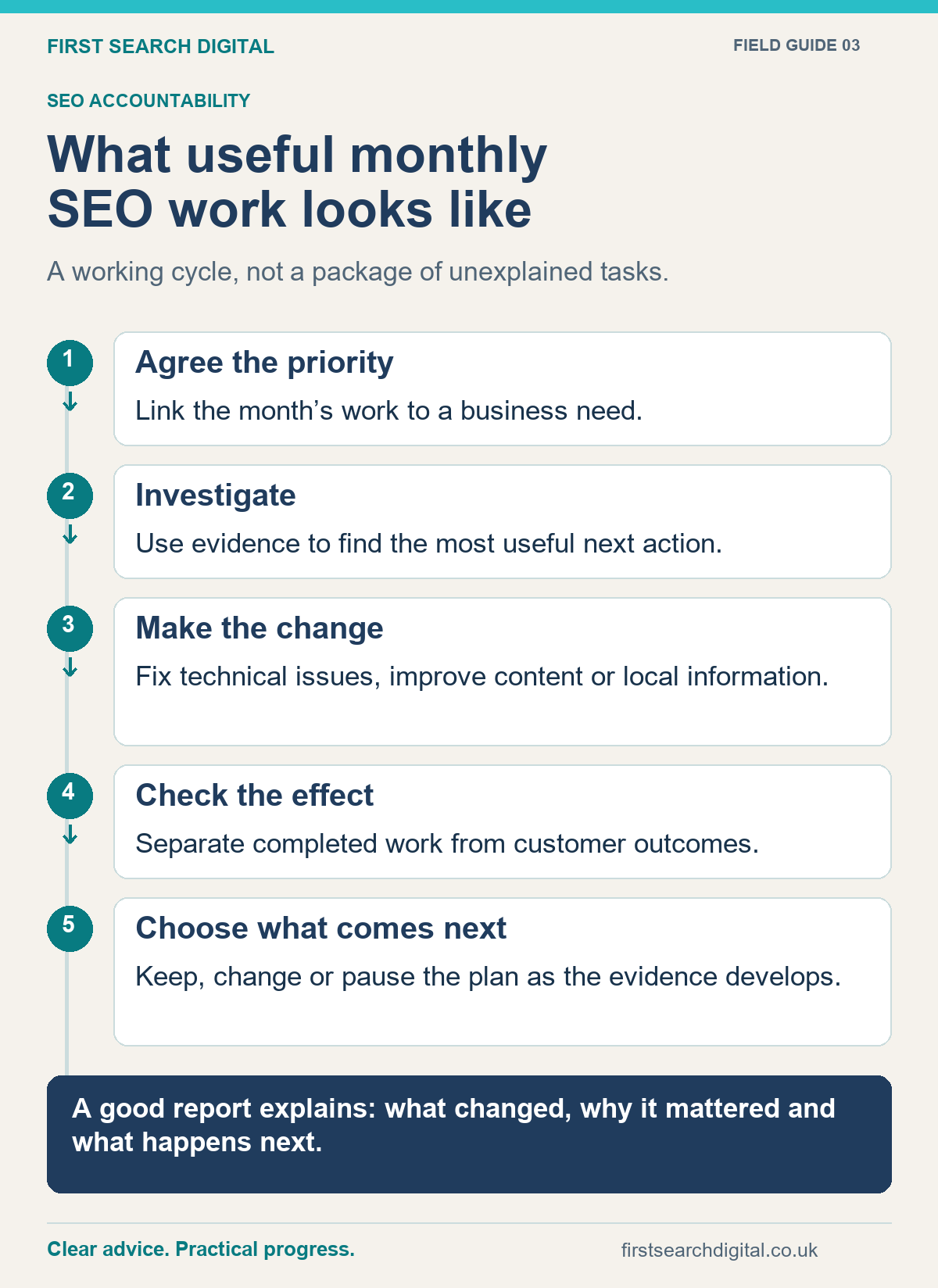
Text version of the infographic: What useful monthly SEO work looks like
What useful monthly SEO work looks like
A working cycle, not a package of unexplained tasks.
Agree the priority — Link the month’s work to a business need.
Investigate — Use evidence to find the most useful next action.
Make the change — Fix technical issues, improve content or local information.
Check the effect — Separate completed work from customer outcomes.
Choose what comes next — Keep, change or pause the plan as the evidence develops.
A good report explains: what changed, why it mattered and what happens next.
Questions worth asking at the next review
- Which business priority did this month’s work support?
- Can I see the pages, fixes or other work completed?
- What changed in relevant visibility, visits or enquiries?
- What else could explain that change?
- What have we learned that affects next month’s plan?
- Do I retain access to the accounts, reports and content?
A good answer can be straightforward. Technical complexity is sometimes unavoidable; an inability or unwillingness to explain the purpose of the work is a different issue.
Agree a plan that can change with the business
Sometimes the next useful task is a website fix or a review of paid advertising. Keeping every pound inside an SEO package may not serve the wider problem.
I charge hourly and agree a monthly plan around business needs, budget and available time. That work can include SEO, PPC, social media or website improvements. I use rolling arrangements without minimum terms or notice periods because I want clients to stay through the quality of the work.
If you would like a clearer view of your current activity, explore SEO and local search support or training to understand your reports. You can also ask me to review what you are paying for.
Put this into practice
If a report mentions page changes, PageSweep can help you inspect titles, descriptions, headings and links. Use it to inform questions about the work, rather than judging a campaign from a tool score.