Yes, a small business owner can manage Google Ads. The better question is whether you have the time, interest and support to manage it well alongside running the business.
Opening an account and launching a campaign is only part of the job. You also need to understand who the ads are reaching, what visitors do next and whether the resulting enquiries are useful. A campaign that keeps spending is not necessarily a campaign that deserves to keep spending.
There are more choices than doing everything alone or handing everything to an agency. Training, an initial setup with a handover, occasional reviews and shared management can all be sensible arrangements.
When managing it yourself makes sense
Doing the work yourself is more realistic when your offer is reasonably clear, the account is manageable and you can make time to learn. You do not need to love spreadsheets, but you do need to be comfortable checking evidence and changing your mind.
A local business promoting one well-defined service may have a more approachable starting point than a retailer with thousands of products, changing stock and several markets. Complexity matters as much as the advertising budget.
Ask yourself:
- Can I explain which customers and jobs are worth attracting?
- Do I have a useful page to send them to?
- Can I distinguish a genuine enquiry from spam or an irrelevant lead?
- Will I set aside regular time to check the account?
- Am I willing to ask for help when I do not understand a setting?
If the answer to most of those questions is yes, learning may be a good investment. If you already struggle to answer enquiries or maintain your website, another system to manage may be the wrong immediate priority.
What you need to understand before spending
The offer and the destination
Be specific about the service, geographical area and next step. A campaign for a specialist repair should lead to a page explaining that repair, rather than asking visitors to work through a general homepage.
Check that the enquiry route works on a phone. Make a test submission, confirm it arrives and establish who will respond. Advertising cannot compensate for a broken form or a vague offer.
What counts as a useful result
Decide what success looks like before looking at the dashboard. A submitted enquiry may be useful; a visit to a contact page is a weaker signal. Neither automatically means a sale.
Keep a simple record of which leads were relevant and what happened next. Your knowledge of the business adds context that a platform cannot supply on its own. If the tracking is unclear, getting help with that foundation may be more valuable than learning another bidding option.
The budget controls
An average daily budget is not always a strict daily spending cap. Google says that, for most campaigns, spending can reach twice the average daily budget on a day, with a monthly limit based on 30.4 times that budget. Budget changes and particular campaign arrangements affect the calculation, so check the current spending-limit guidance for your setup.
Keep advertising spend separate from training, management and website costs in your plan. A £300 media budget and a £300 total marketing budget are different starting points.
What good Google Ads training should leave you able to do
I would judge training by the decisions you can make afterwards, rather than how many screens are covered. A useful session should connect the account to your actual business.
- Explain the purpose of each campaign and why it exists.
- Recognise the main budget, location and targeting settings.
- Understand the difference between the keywords you choose and the searches people make.
- Check that the right actions are being measured.
- Identify obvious irrelevant traffic and decide what to investigate.
- Know how to pause spending and when to ask for help.
Google’s search terms report is one useful place to examine the searches associated with your ads. The report and its availability depend on the campaign and reporting rules; it should support a wider review rather than become the only thing you check.
Ask the trainer to work through a real example, explain the reasoning, then let you repeat the task. Written notes and a short review routine are often more useful than a long recording you never revisit.
Three practical ways to share the work
Learn and run it yourself
You own the day-to-day decisions after a structured setup or training session. This suits someone who wants the skill and can maintain the routine. Agree what is included in the handover and whether a later review is available.
Run it yourself with periodic support
You handle familiar checks, while a specialist reviews the account at an agreed interval or helps with specific changes. This can work well when the basics are stable but you want a second pair of eyes.
Be clear about who is watching the budget between reviews. “Occasional support” should not create an assumption that someone else is monitoring everything.
Use ongoing management
You provide business priorities, capacity and lead feedback; the specialist handles the agreed account work. This may suit a complex account or an owner whose time is better spent elsewhere.
You should still understand the plan, have appropriate access to your account and know how costs are split. Delegation works better when you remain involved in judging lead quality.
A manageable review routine
Set a regular appointment with yourself. Check spending against the plan, look for tracking problems and review the quality of enquiries. Note any changes to the business: a full diary, a service you have stopped offering or a product that is unavailable.
Record significant changes and the reason for them. If you change the offer, landing page, targeting and budget simultaneously, it becomes harder to understand what influenced the result. Equally, do not leave an obvious fault running merely to preserve a tidy experiment.
A review frequency should reflect spend, activity and risk. There is no honest universal promise that every account needs only a fixed number of minutes each week.
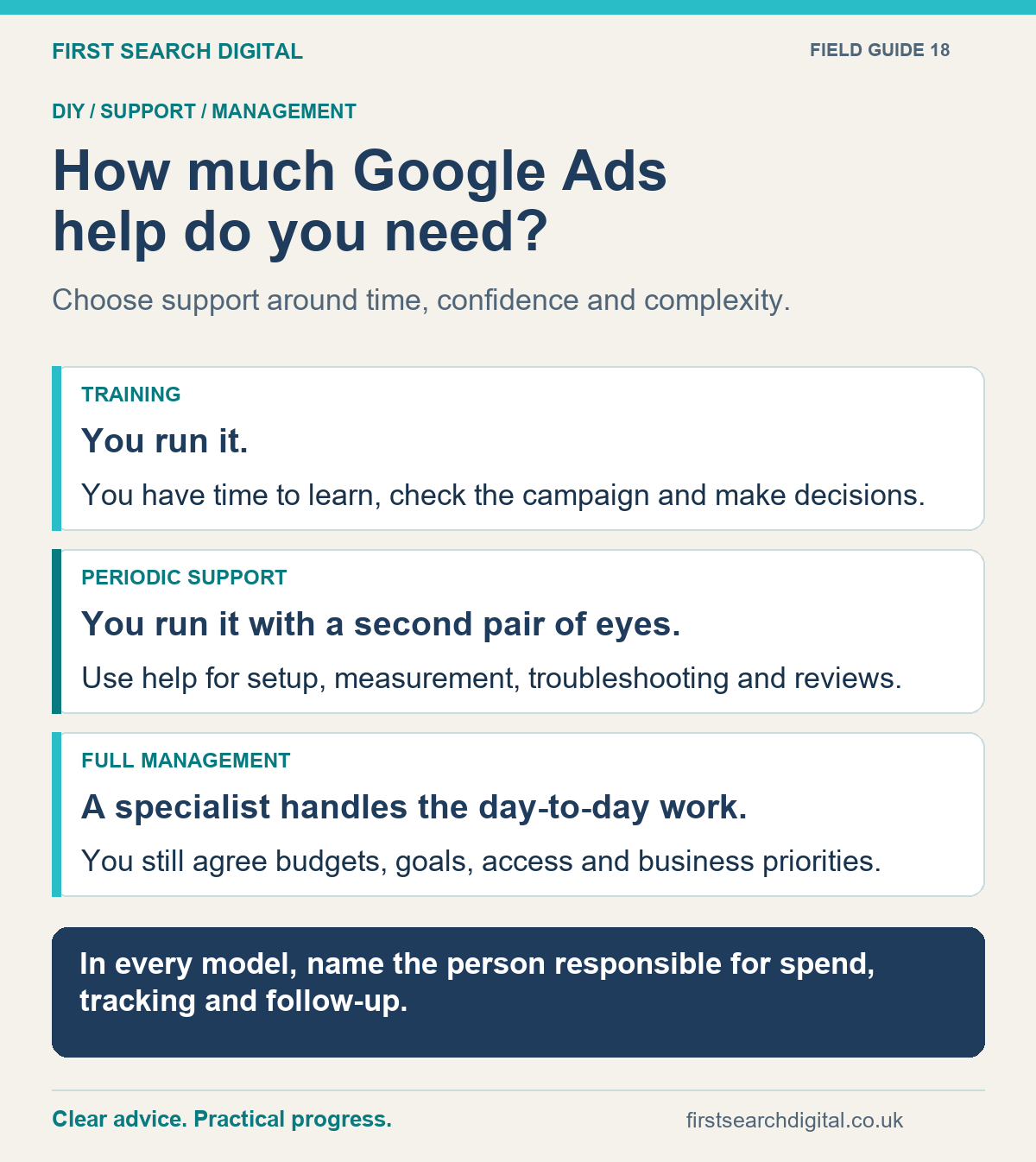
Text version of the infographic: How much Google Ads help do you need?
How much Google Ads help do you need?
Choose support around time, confidence and complexity.
TRAINING — You run it. — You have time to learn, check the campaign and make decisions.
PERIODIC SUPPORT — You run it with a second pair of eyes. — Use help for setup, measurement, troubleshooting and reviews.
FULL MANAGEMENT — A specialist handles the day-to-day work. — You still agree budgets, goals, access and business priorities.
In every model, name the person responsible for spend, tracking and follow-up.
Choose support that helps you stay in control
I offer practical PPC training as well as Google Ads support. We can work on a specific problem, build your confidence or agree ongoing work around the budget and time available.
The right arrangement is the one you can sustain and understand. If a campaign is not ready for more spending, I would rather explain what needs fixing first than encourage you to increase the budget.
Put this into practice
Before paying for more clicks, work through the Website & SEO Health Check to review the website and enquiry journey those visitors will reach.