A limited budget needs a clear order of work. It does not need an attempt to do a little bit of every marketing activity at once.
The aim is to choose a manageable improvement, finish it properly and use what you learn to decide the next step. That might mean working on SEO this month and the website next month. It may also mean deliberately postponing something attractive but less important.
Start with the business pressure
Are you short of enquiries, receiving the wrong kind of work, struggling to convert interest or spending too much time answering the same questions? These are different problems, with different costs.
Choose one immediate priority and be specific. “More suitable enquiries for our maintenance service” gives a plan direction. “Improve our online presence” is too broad to decide which task should come first.
Consider capacity and cash flow too. If a busy period is approaching, making booking and response processes easier may be more useful than increasing demand you cannot accommodate.
Protect what already brings customers
Before starting a new channel, check the basics around existing demand. Does your main service page reflect what you do? Is the enquiry route working? Can people find accurate opening hours or service information? Are important website renewals and maintenance covered?
These tasks can seem less exciting than a new campaign, but a broken route from interest to enquiry affects money you have already spent attracting attention.
This is not an argument for endless housekeeping. Fix the important obstacle, verify it and move on.
Compare a short list of possible tasks
Write down three to five candidates. For each, consider expected benefit, evidence, effort and dependencies. Use plain descriptions such as high, medium or low if you do not have enough information for numbers.
- Benefit: which business outcome might improve?
- Evidence: what suggests this problem actually exists?
- Effort: what will delivery cost in money and your time?
- Dependencies: what must happen before the task can work?
A contact form that demonstrably fails has stronger evidence than a guess that a new platform will bring customers. A campaign may have potential, but depend on creating a suitable page first.
Use the comparison to support judgement, not to manufacture a precise return forecast from uncertain inputs.
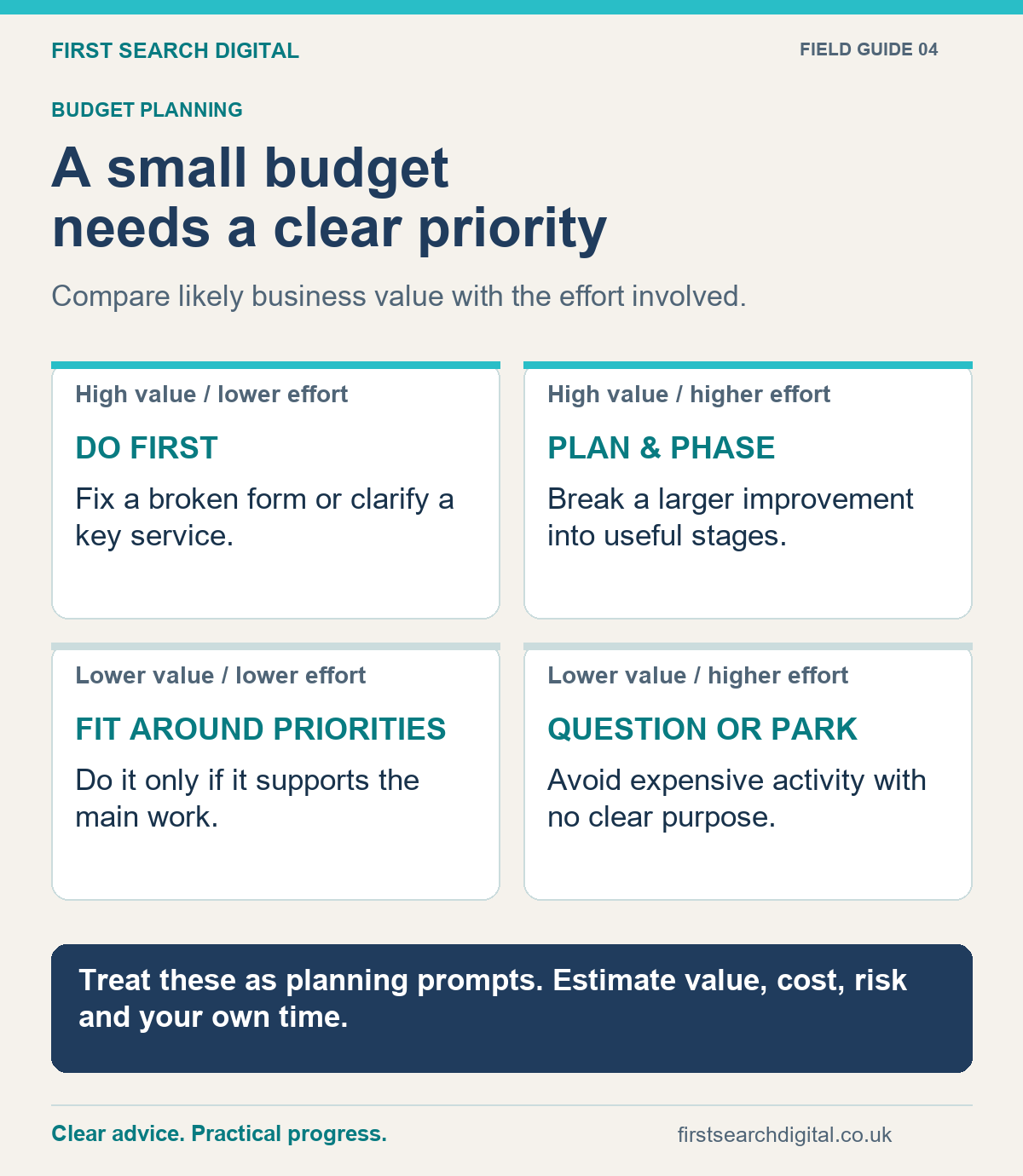
Text version of the infographic: A small budget needs a clear priority
A small budget needs a clear priority
Compare likely business value with the effort involved.
High value / lower effort — DO FIRST — Fix a broken form or clarify a key service.
High value / higher effort — PLAN & PHASE — Break a larger improvement into useful stages.
Lower value / lower effort — FIT AROUND PRIORITIES — Do it only if it supports the main work.
Lower value / higher effort — QUESTION OR PARK — Avoid expensive activity with no clear purpose.
Treat these as planning prompts. Estimate value, cost, risk and your own time.
Allow for the owner’s time
Marketing you do yourself is not costless. Taking photographs, approving copy, answering messages and learning tools all use time that could go into customers or running the business.
A useful arrangement divides work according to who is best placed to do it. You may supply the service knowledge and examples while someone else turns them into a clear page. Training can also reduce ongoing dependence where you want to manage routine updates yourself.
If a task repeatedly stalls because nobody has time to supply information, change its scope or choose a different priority. A half-finished campaign creates little value.
Make the monthly plan small enough to finish
For illustration, a business with six hours available might allocate one hour to reviewing enquiries, three to improving a priority page, one to checking the contact journey and one to recording results and next actions. Those figures are an example of planning, not a price or delivery promise.
Write down what is included, who supplies information and what “finished” means. For a page update, completion should include checking it on a phone and testing its links, rather than simply saving the text.
Keep advertising spend, professional time and software costs visible as separate items. A low management fee tells you little about the complete cost of a campaign.
Review the decision, not just the activity
At the end of the period, ask what was completed, what evidence appeared and whether the original priority still holds. Record uncertainty, particularly when enquiry numbers are small.
Some work produces an immediate operational benefit, such as a repaired form. Search improvements may take longer to assess. Set review periods according to the task instead of demanding that every activity prove itself on the same timetable.
It is reasonable to slow down or pause
Businesses have quieter periods and changing financial pressures. A sensible plan should make room for them. If you pause, identify any essential maintenance, renewals or active advertising that still needs attention so the pause is deliberate.
My support is hourly, with the scope agreed around your budget and available time. There is no minimum contract term or notice period. A smaller budget means choosing a smaller scope, not promising the same volume of work for less.
Read how the monthly arrangement works, use the free health check to identify possible gaps, or tell me your immediate priority.
Put this into practice
For help turning your priorities into a manageable scope, explore digital business consultancy. The free tools collection can also help with small checks you want to manage yourself.