The names describe overlapping ways of helping people discover and understand your business. They do not necessarily represent four separate services you need to buy.
Search has expanded beyond a list of links. Customers may see map results, short answers, AI summaries, videos or recommendations, then move between them before deciding whom to contact. The terminology has expanded too, sometimes faster than agreement about what each label means.
SEO: search engine optimisation
SEO is the broad work of helping search engines access and understand your pages, and helping relevant people find and use them. It can include technical repairs, clearer service information, content, internal links and local visibility.
For a small business, a useful SEO plan should connect that work with suitable customers. Being visible for an unrelated high-volume search is not automatically valuable.
GEO: generative engine optimisation
GEO is commonly used for work intended to improve visibility within answers generated by AI systems. Those answers may name businesses, summarise information or link to sources.
The label is used across different products, which do not all use the same systems or display sources in the same way. Ask which services a proposal covers and what “visibility” means: a mention, a linked citation, a visit or a customer enquiry?
A citation is not a promise of a click. A one-off appearance for a handpicked prompt is not proof that a business is consistently recommended.
AEO: answer engine optimisation
AEO usually describes making information useful for systems that provide direct answers. Depending on the provider, that may include traditional answer features, voice responses or generative search.
A practical activity could be improving a confusing service explanation so a question has a clear, accurate answer. Useful structure matters, but there is no universal template that guarantees an answer feature.
AIO: an abbreviation that needs context
In search reporting, AIO often means AI Overview or AI Overviews, Google’s summary feature. Some marketers use it to mean AI optimisation, which could cover several different activities.
Those meanings are not interchangeable. If a proposal promises “AIO work”, ask the author to spell it out and list the deliverables. Do not agree to an unfamiliar label because it sounds like something you must be missing.
Where local SEO and PPC fit
Local SEO concentrates on discovery for location-related needs, including relevant website information and eligible business profiles. PPC is paid advertising, where you pay according to the campaign’s charging model, commonly for clicks in search campaigns.
Paid and organic activity can inform each other, but buying advertising does not buy better organic rankings. They need separate budgets and reporting.
What is actually connected?
Consider a hypothetical local repair business. Its service page explains the fault types it handles, its profile shows accurate business details, a guide answers an important customer question and its contact route works on a phone.
Those are useful foundations whether a customer arrives from an ordinary search result, an AI citation, a map listing or a recommendation from a friend. They also give a human reader a clearer basis for deciding whether to enquire.
Google’s guidance for generative AI search features keeps established SEO practices central. It does not prescribe a special AI text file or a separate set of tricks as a requirement for visibility. This is guidance for Google; it should not be treated as a specification for every AI product.
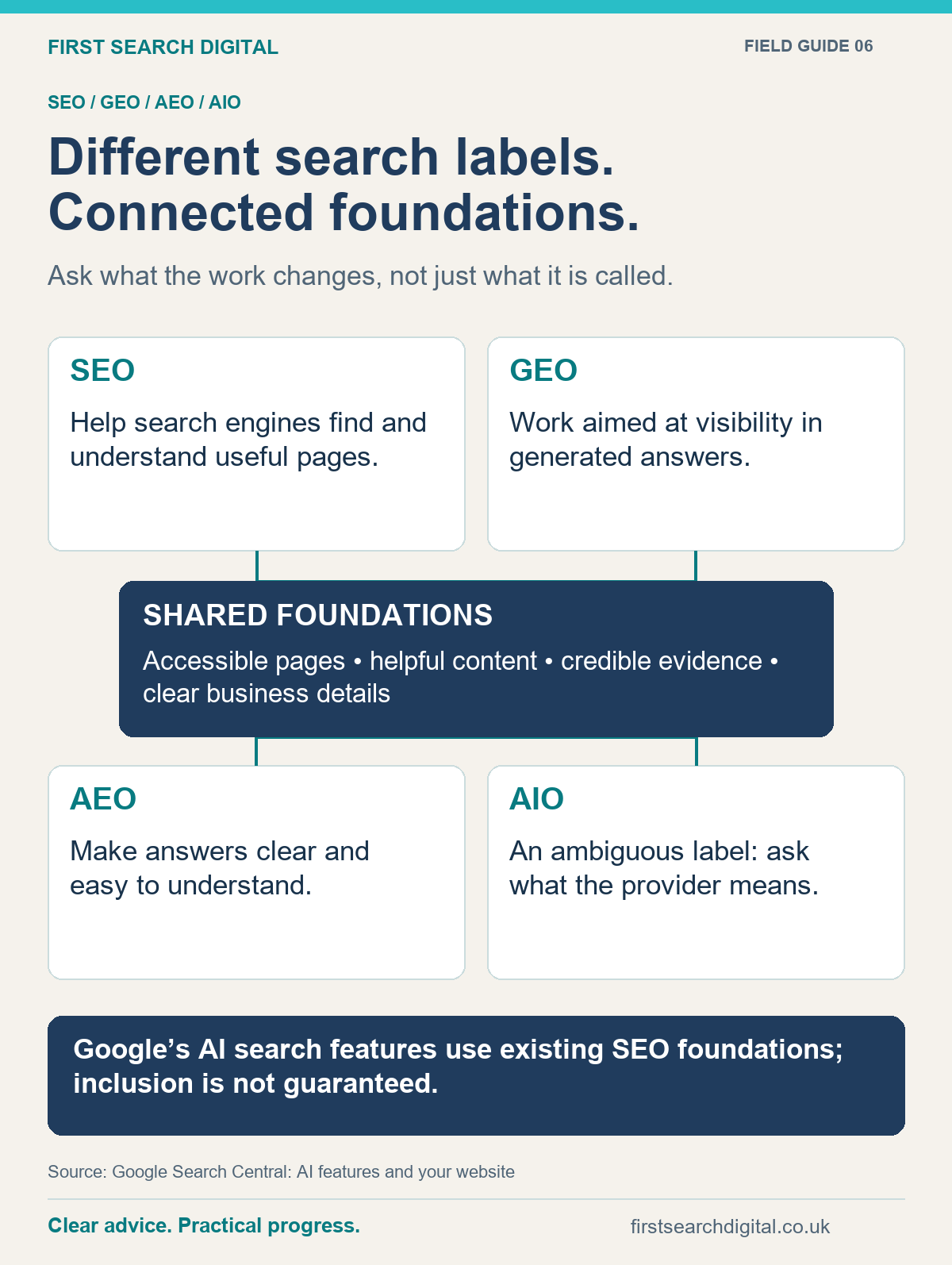
Text version of the infographic: Different search labels. Connected foundations.
Different search labels. Connected foundations.
Ask what the work changes, not just what it is called.
SEO — Help search engines find and understand useful pages.
GEO — Work aimed at visibility in generated answers.
AEO — Make answers clear and easy to understand.
AIO — An ambiguous label: ask what the provider means.
SHARED FOUNDATIONS: Accessible pages • helpful content • credible evidence • clear business details
Google’s AI search features use existing SEO foundations; inclusion is not guaranteed.
Sources: Google Search Central: AI features and your website.
What should a useful proposal contain?
- A defined audience: the customers and questions the work addresses.
- Named activities: the pages, technical issues or information to improve.
- Evidence: what suggests those changes are needed.
- Measurement: how visibility, visits and business outcomes will be distinguished.
- Limits: what the supplier cannot control or guarantee.
If several packages all include the same page updates and technical checks, ask how the scopes differ. Paying for additional specialist research can be reasonable; paying repeatedly for the same task under different abbreviations is worth questioning.
A manageable starting point
Write down the questions customers ask before they contact you. Check whether your website answers them clearly and supports its claims with relevant evidence. Then check that important pages can be found and used.
Keep a record of the work and review what happens to relevant searches and enquiries. Avoid treating an isolated screenshot of an AI answer as a performance report.
The free website and SEO health check is a useful starting point. For a more focused review, explore AI visibility audits and AI search visibility support.
Put this into practice
Start with the page you already have: PageSweep helps inspect titles, descriptions, headings and indexing instructions. It does not predict AI citations or replace a wider visibility review.