Start with the problem preventing useful business, then choose the work that addresses it. A company nobody can find needs a different plan from one receiving plenty of visits but very few suitable enquiries. Buying the same marketing package for both would miss that distinction.
If you run a small business, you probably cannot fund every channel at once. Nor should you have to. The first decision is where your next block of time or money is most likely to make a worthwhile difference.
Describe what you want more of
“More traffic” is a starting observation, not a complete business goal. Which service do you want to sell? To whom? In which area? How many additional customers could you look after properly?
For example, a business might want more enquiries for planned work within a manageable travelling distance, rather than urgent requests from across the county. That changes the pages, search terms and advertising messages worth investing in.
Write the goal in one sentence: “We want more enquiries from [customer] for [service] in [area], and we have capacity for [amount of work].” You now have something useful against which to judge a recommendation.
Find the point where customers get stuck
People do not discover you
Check whether the website clearly covers the service people need and whether relevant searches bring impressions or visits. Review your Google Business Profile if your business is eligible, and ask recent customers where they first heard about you.
This is where SEO and local search work may help. The work could involve clearer service pages, technical repairs or better business information. Publishing more blog posts is only one possible activity.
People visit but do not enquire
Open the page they arrive on using your phone. Can you immediately tell what is offered, who it suits, where the business works and how to take the next step? Is there credible evidence of the work? Does the contact route actually function?
Improving those things may be a better first purchase than another campaign. An existing website can often be improved in stages; a disappointing enquiry rate does not automatically justify rebuilding everything.
Enquiries arrive, but they are unsuitable
Look at the promise being made. A broad advert, unclear service area or missing explanation of the type of work you accept can attract people you cannot help. Tightening the message may reduce enquiry numbers while making the remaining enquiries more useful.
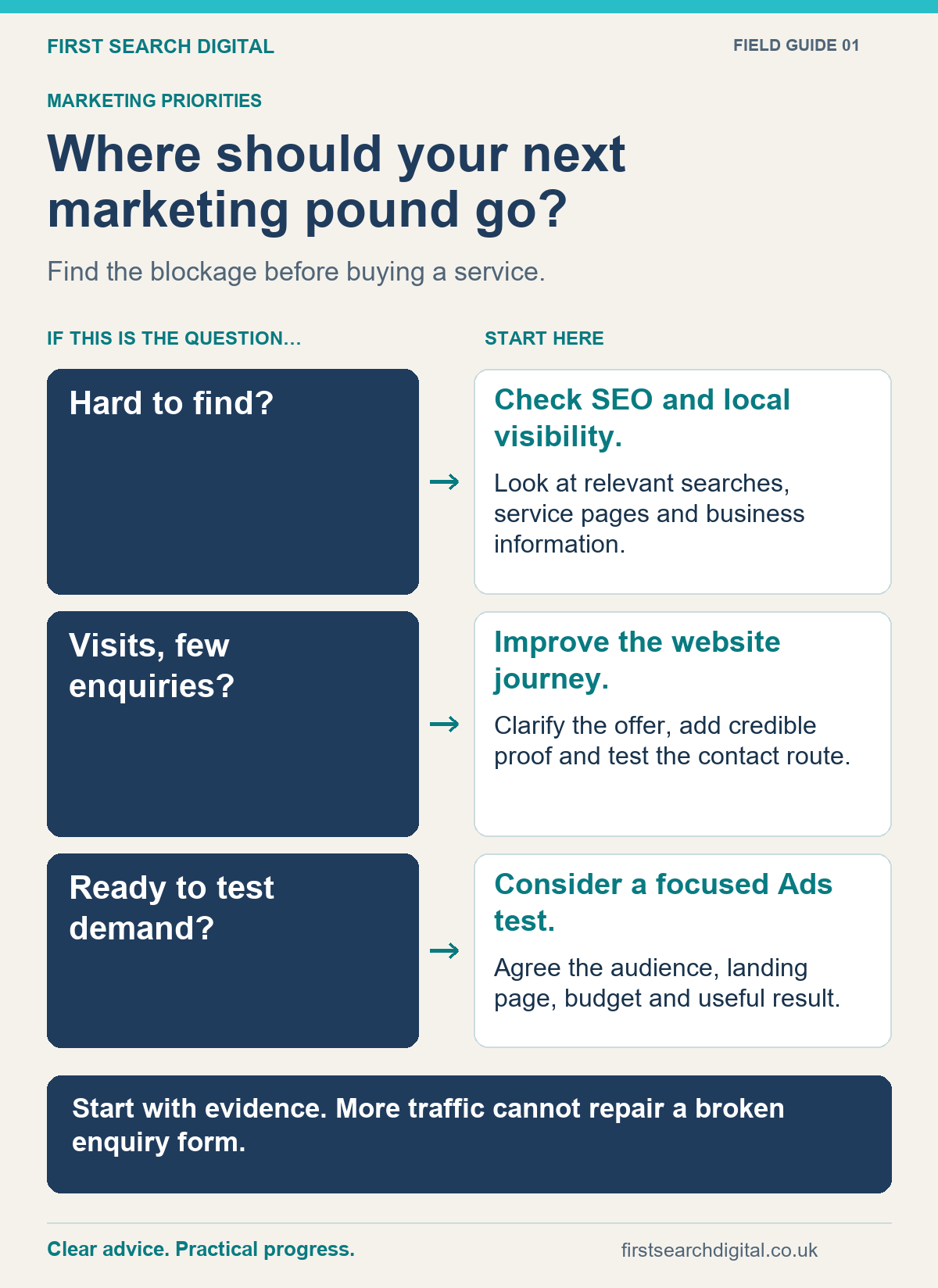
Text version of the infographic: Where should your next marketing pound go?
Where should your next marketing pound go?
Find the blockage before buying a service.
Hard to find? — Check SEO and local visibility. — Look at relevant searches, service pages and business information.
Visits, few enquiries? — Improve the website journey. — Clarify the offer, add credible proof and test the contact route.
Ready to test demand? — Consider a focused Ads test. — Agree the audience, landing page, budget and useful result.
Start with evidence. More traffic cannot repair a broken enquiry form.
When Google Ads is a sensible option
Search advertising can be worth testing when people already search for what you sell, your offer is clear and you can respond to enquiries. Google’s Search campaign guidance explains how these campaigns reach people searching for products or services.
Before spending, agree the target service, geographical coverage, landing page, measurement and maximum test budget. Separate the advertising spend from the cost of managing the campaign.
Ads can generate visibility sooner than waiting for organic improvements, but speed does not guarantee profitable customers. If each job leaves a small margin or clicks are expensive, the economics may be difficult. A useful test needs enough evidence to support a decision, not merely a few days of impressions.
When the website should come first
Prioritise the website when a technical fault prevents contact, the offer no longer reflects the business, mobile use is difficult or customers cannot judge whether you are suitable. These issues affect people arriving from referrals and social media as well as search.
Choose one important customer journey and fix it from beginning to end. That might mean rewriting a service page, adding relevant proof and testing the enquiry process. Keep the scope specific enough to finish and evaluate.
How the work can fit into one monthly plan
A hypothetical first month might focus on repairing a form and clarifying a profitable service. The next could test a tightly scoped search campaign. Later work might improve organic visibility for the same service using what the enquiries have taught you.
That sequence is an example, not a standard prescription. A business with a strong website and no local visibility could reasonably start elsewhere.
My approach is to agree a plan at the beginning of the month around your business needs, budget and the time available. The work can move between SEO, PPC, social media and the website as priorities change. You can read more about working together.
Five questions before you spend
- Which business problem are we addressing?
- What evidence suggests this is the right starting point?
- What needs to work before this activity can succeed?
- What will the total cost include?
- When will we review the evidence and decide what happens next?
If those answers are unclear, start with a focused review. The free website and SEO health check can help organise your observations. If you want help deciding between them, tell me what you want the business to achieve.
Put this into practice
For help putting the chosen priority into practice, explore digital business consultancy. The Website & SEO Health Check can give that first conversation a useful starting point.