A campaign is useful when it helps bring the right business at a cost you can sustain. Clicks, impressions and a rising conversion count can help explain performance, but none proves that on its own.
Start with the customer outcome, then work backwards through the reporting. That makes it easier to see whether the problem is measurement, targeting, the website or what happens after someone enquires.
Agree what counts as a meaningful result
For a service business, an initial enquiry, a qualified enquiry and a paying customer are different stages. A person requesting work outside your service area may complete the form perfectly and still be unsuitable.
Define the stages in language the business uses. A qualified enquiry might require the right service, location and realistic timescale. Record whether it becomes a quote, booking or completed job.
Google’s conversion tracking documentation describes measuring valuable actions after ad interactions. Which actions you configure determines what the conversion numbers actually mean.
Check that tracking reflects those actions
Test whether a form conversion is recorded only after a successful submission, whether duplicate events are counted and whether a button click is being mistaken for a completed enquiry.
A phone-link click is not necessarily a connected call. A downloaded brochure is not necessarily a qualified prospect. These can be useful secondary observations, but should not be silently combined with sales and treated as equivalent wins.
Review which conversion goals campaigns use for reporting and bidding. Google’s conversion measurement options cover website, call and offline activity. Configure a setup appropriate to the business, with the necessary privacy information and consent where required.
Connect reports with actual enquiries
Keep a simple record of enquiry date, source where known, service requested, suitability and outcome. Do not put unnecessary personal information into marketing reports.
Compare the log with campaign reporting while allowing for differences in attribution and timing. Platforms can assign credit differently, and a customer may encounter several channels before contacting you. Reported conversions are not a complete independent account of causation.
For higher volumes, a carefully configured CRM and offline outcome tracking may be appropriate. For a small business, a consistent manual review can already reveal obvious quality problems.
Calculate costs at the stage that matters
As an illustrative example, suppose £400 of advertising produces 20 enquiries. The advertising cost per enquiry is £20. If only five are suitable, it is £80 per suitable enquiry. If two become customers, the advertising cost per customer is £200.
Those figures describe the same campaign. None includes management fees, software or the cost of responding. The example is arithmetic, not a forecast of typical performance.
Compare the complete acquisition cost with the contribution a customer leaves after delivery costs, not just the sales value. If you use an estimate of repeat business, make its assumptions visible rather than treating future revenue as certain.
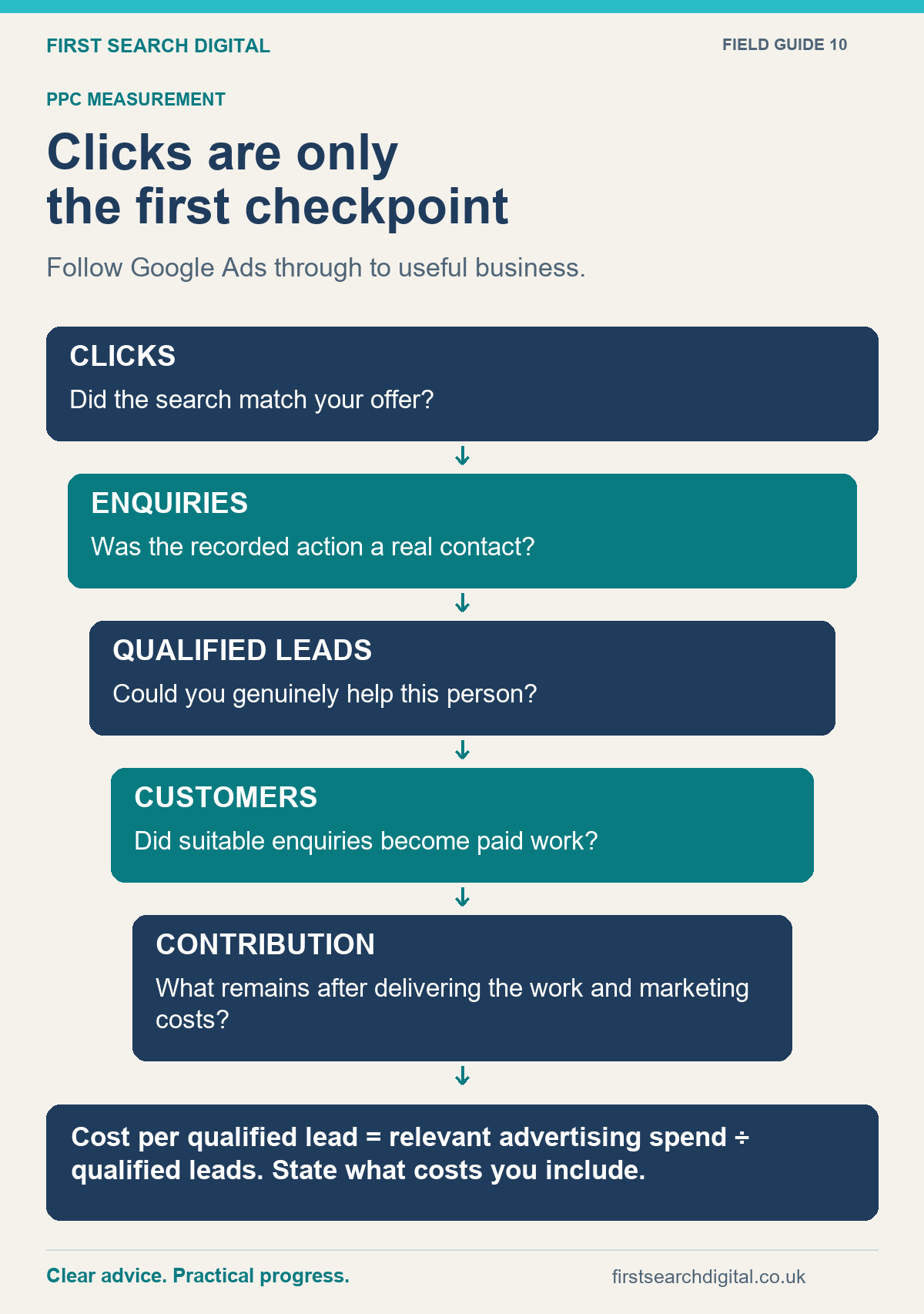
Text version of the infographic: Clicks are only the first checkpoint
Clicks are only the first checkpoint
Follow Google Ads through to useful business.
CLICKS — Did the search match your offer?
ENQUIRIES — Was the recorded action a real contact?
QUALIFIED LEADS — Could you genuinely help this person?
CUSTOMERS — Did suitable enquiries become paid work?
CONTRIBUTION — What remains after delivering the work and marketing costs?
Cost per qualified lead = relevant advertising spend ÷ qualified leads. State what costs you include.
Inspect the searches and the promise
Review relevant search terms, geography, campaign messages and landing pages. Are you attracting people looking for your actual service, or a related task you do not provide?
The search terms report shows available queries that triggered ads, but it does not expose every query; privacy thresholds limit some reporting. Use it alongside the broader account evidence.
Check whether an advert promises something the landing page does not support. Better targeting cannot fully compensate for an unclear offer or an enquiry route that fails on mobile.
Allow enough time for the buying process
A same-day purchase and a project that takes weeks to approve need different review windows. Recent leads may not yet have had time to become customers.
Compare like with like and note changes in seasonality, budget, services or availability. A small number of leads can produce large percentage swings, so be cautious about declaring success or failure from a short period.
Choose the next action from the evidence
- Many irrelevant enquiries: review targeting, search terms and the offer.
- Relevant clicks but few enquiries: test the landing page and contact journey.
- Suitable enquiries but few sales: review response, suitability criteria and the sales process.
- Good outcomes at an acceptable cost: test expansion carefully and monitor whether quality holds.
For help, explore Google Ads support, conversion tracking or PPC training. The aim is a report you can use to make a decision.
Put this into practice
Use the Website & SEO Health Check to review the landing-page and enquiry journey alongside your campaign figures. It does not access your advertising account or validate conversion tracking.