A promise to raise your website’s authority score can sound reassuring. So can a report full of green arrows, hundreds of new links or a monthly invoice labelled “optimisation”. The important question is what any of it has actually done for your business.
Small business owners should not need to become SEO specialists to understand what they are paying for. You should be able to ask what work is proposed, why it matters, how the price is calculated and what evidence you will receive.
Some marketing offers are deliberately deceptive. Others are poor value, badly explained or simply unsuitable. A disappointing result does not prove fraud, and an expensive specialist is not automatically ripping you off. This guide separates the warning signs from legitimate ways of charging for useful work.
Selling DA or DR increases as guaranteed success
Domain Authority, or DA, is a metric developed by Moz. Domain Rating, or DR, is Ahrefs’ measure of a website’s backlink profile. They are third-party estimates, not scores awarded by Google. Moz explains this distinction in its authority scoring guide, and Ahrefs says there is no evidence that search engines use DR or similar scores as ranking factors.
These tools can help an experienced person compare sites and investigate links. The problem starts when improving the number becomes the product, with no meaningful explanation of how it should help your customers find you.
For example, a hypothetical offer might promise to move a site from DR 10 to DR 50 for £1,000. Even if the seller achieves that change, you have not necessarily bought better search visibility, relevant visitors or enquiries. Ahrefs itself warns against making authority improvement the main goal and notes that DR does not incorporate variables such as traffic or link spam. See its explanation of Domain Rating.
My concern would be the work behind the number. Which websites will link to yours? Are they relevant? Would anyone use those pages? Are the links earned, sponsored, rented or part of a network? What happens when the subscription stops?
- Ask for the proposed method and examples of the actual linking pages.
- Ask which services, locations and customer searches the work is intended to support.
- Agree business measures alongside any third-party metrics.
- Do not treat a screenshot of an increased score as proof of a return on your money.
Guaranteed rankings and supposed special access
“First on Google” is incomplete without knowing the query, location, device and type of result. Appearing for your own unusual business name says little about winning customers searching for the service you sell.
Google explicitly warns that nobody can guarantee a number-one ranking. It also says paying for advertising does not improve organic placement. A supplier’s claimed special relationship with Google is no substitute for a credible plan. These points are covered in Google’s advice on hiring an SEO.
A responsible supplier can commit to agreed work, reporting and communication. They can explain an informed expectation and its assumptions. They cannot control every competitor, search result or platform change.
Large link packages with little scrutiny
A package of thousands of backlinks may look better value than a smaller piece of careful work. Quantity tells you very little about whether those links make sense for your business.
Google’s link spam policy covers links created primarily to manipulate rankings. A supplier should explain the sources and purpose rather than reassure you with labels such as “safe”, “high authority” or “grey hat”.
Paying someone to research a story, create a useful resource or approach relevant publications is different from buying a ranking promise. Advertising and sponsorship can also be legitimate. Google explains how paid placements should be identified in its guidance on qualifying outbound links.
I would ask what remains useful if the promised ranking benefit never arrives. Genuine coverage, referral visitors and a resource customers use have a clearer purpose than a list of unexplained URLs.
Inflated hours and unclear pricing
If you agree to pay for actual time worked, the time recorded should be honest. Billing ten hours for two hours of work while presenting the invoice as actual hours is a different matter from agreeing a fixed price for a completed job.
But judging every task by the few minutes you see on screen can also be misleading. Diagnosis, research, preparation, testing, communication and responsibility may all be part of the work. An experienced person may solve something quickly precisely because they have spent years learning how.
Understand which pricing model you are buying
- Hourly work: agree the rate, what counts as billable time, billing increments and a limit that needs approval before being exceeded.
- Fixed-price work: agree the deliverable, assumptions, revisions, testing and what would count as extra work. A faster completion does not automatically change an agreed fixed fee.
- A monthly retainer: establish whether it buys a set number of hours, defined activities, reserved availability or a combination. Ask what happens to unused time.
- A value-based fee: the price reflects the agreed value and responsibility rather than a timesheet. That basis should be clear before you commit.
These models can all be fair. Trouble starts when the basis changes without explanation, estimated hours are passed off as actual hours, or ordinary questions about an invoice are treated as unreasonable.
Ask for a record you can understand
A useful work record might say which campaign was reviewed, which landing page was changed, what was tested and why. You should not need a minute-by-minute account of every mouse movement, but “SEO work: ten hours” is not much help when you are trying to understand progress.
Agree what preparation, project management and reporting include. If automation reduces a repetitive task, ask how that affects the agreed service. Tools can improve delivery, but a supplier should not invent manual hours that were never worked.
Advertising spend that hides the management fee
When someone quotes £1,000 a month for advertising, establish how much reaches the advertising platform and how much pays for management, creative work, software and other charges. Also establish whether VAT is included where applicable.
A management fee, percentage fee or disclosed markup can be legitimate. Describing the whole payment as media spend when a substantial amount is retained elsewhere gives you a false picture of what was bought.
Ask for access to the relevant account, the actual platform spend and a clear reconciliation with the invoice. Compare the same dates and currency. The arrangement should let you understand costs without depending on selected screenshots.
Reports designed to impress rather than explain
More impressions, followers or website visits may be useful. None establishes that your marketing is profitable on its own.
Watch for reports that mix paid and organic traffic, compare an unusually quiet month with a busy season, count existing customers as new leads, or call a button click a completed sale. These may be reporting mistakes rather than deliberate deception, but they still need correcting.
A sensible report separates activity from outcomes. It explains what changed, how reliable the tracking is, which enquiries were relevant and what should happen next. For a local service business, five appropriate enquiries may matter more than thousands of visitors who will never become customers.
Fake reviews, followers and borrowed proof
Purchased praise is a weak foundation for trust. Google’s Maps contribution policy prohibits fake engagement, incentivised reviews and selectively soliciting positive reviews.
Use a consistent, neutral request for feedback from real customers. Do not buy a five-star package or offer a discount for a favourable review. A supplier who suggests that everyone does it is avoiding the real question: whether you are comfortable putting your reputation behind it.
Also check portfolio claims. Ask what the supplier actually did, when they did it and whether the example is comparable to your business. A recognisable logo alone does not show the scale of involvement or the outcome.
Scare-based audits and the churn-and-burn sales model
An automated audit can identify useful issues. A long list of red warnings is not automatically a diagnosis, and every warning does not deserve equal budget.
Ask the person to show the issue on your site, explain the practical effect and identify the first few priorities. Be cautious if they cannot distinguish a broken enquiry form from a cosmetic score improvement, or insist that an immediate expensive rebuild is the only answer without examining alternatives.
A churn-and-burn approach puts more energy into acquiring the next client than serving the current one. Warning signs include ambitious sales promises followed by generic work, no clear owner of the account, repeated unexplained delays and reports that never connect with your business.
One missed deadline is not proof of that model. A repeated pattern, combined with evasive answers, is a reason to review the relationship.
Fake opportunities and messages pretending to be someone else
Not every marketing scam is a supplier selling services. A large proposed project, an urgent account warning or an unexpected invoice can be the reason given for opening a file, signing in somewhere or sending money.
Verify the sender through contact details you find independently. A familiar logo, links to genuine social accounts or a domain that redirects to a real brand do not establish who sent the message. Avoid opening unexpected archives or installing software to view a proposal.
This is an area where a calm second check is worth more than a rushed response to an apparently exciting opportunity.
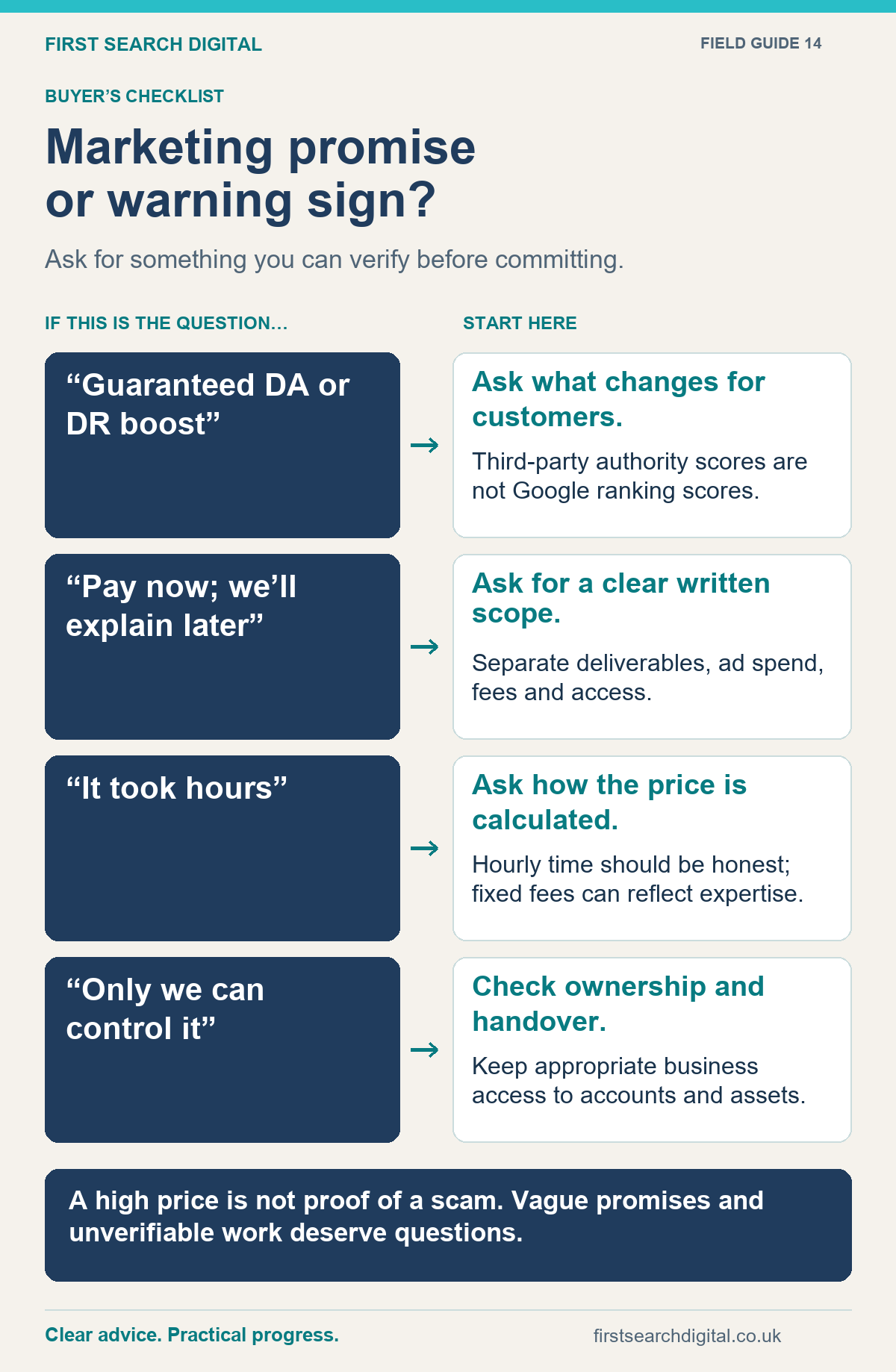
Text version of the infographic: Marketing promise or warning sign?
Marketing promise or warning sign?
Ask for something you can verify before committing.
“Guaranteed DA or DR boost” — Ask what changes for customers. — Third-party authority scores are not Google ranking scores.
“Pay now; we’ll explain later” — Ask for a clear written scope. — Separate deliverables, ad spend, fees and access.
“It took hours” — Ask how the price is calculated. — Hourly time should be honest; fixed fees can reflect expertise.
“Only we can control it” — Check ownership and handover. — Keep appropriate business access to accounts and assets.
A high price is not proof of a scam. Vague promises and unverifiable work deserve questions.
Seven questions before you agree to the work
- What business problem are we trying to solve?
- What exactly will you do, and what will I receive?
- Is the price based on actual hours, a fixed deliverable or another arrangement?
- Which platform, software and third-party costs are separate?
- Will I retain the access and ownership I need?
- How will we distinguish useful progress from a better-looking score?
- What happens if priorities change or I need to pause?
If you are already concerned, keep copies of the proposal, invoices, reports and correspondence. Ask for a factual breakdown of the disputed work, and consider an independent review before authorising further spend. A discrepancy deserves investigation, not an immediate public accusation.
What you should expect from me
I believe in honesty, transparency and integrity. At the start of the month, we agree work around your business needs, budget and available time. That might involve SEO, PPC, social advertising or website improvements rather than forcing every problem into one package.
I charge hourly and explain the priorities. I do not use a minimum term or notice period to retain clients, and I understand that businesses sometimes need a financial break. I want people to stay because the work helps them.
You can read how we work together or ask for a second opinion on a marketing proposal.
Put this into practice
If you need an independent view of proposed work, explore SEO and local search support. The free Website & SEO Health Check can help you identify practical priorities before discussing a package.