A marketing conversation should leave you clearer about your business, not wondering whether you need to learn a new language. Acronyms can be useful shorthand, but only when everyone understands what they mean.

Publication history: This guide incorporates and updates “Digital Marketing Jargon”, first published on Finn McCool Marketing on 20 January 2019. The current guide was consolidated and reviewed on 17 October 2026.
This updated reference covers the terms small businesses are most likely to encounter in proposals, reports and discussions about their websites.
You do not need to memorise them. Use the sections below as a reference, and ask anyone advising you to connect the term to a practical decision.
Search and SEO · AI and search · Paid advertising · Results and measurement · Websites and content · A worked example
Search and SEO
SEO: search engine optimisation
Work that helps search engines understand your website and helps appropriate people find useful pages through unpaid search results. It includes content, technical work and how pages connect. SEO does not buy a guaranteed position.
Organic search
Unpaid search listings, as distinct from advertising placements. Organic traffic is not cost-free to earn: research, writing, website work and ongoing maintenance still take time.
SERP: search engine results page
The page of results shown after a search. It may contain conventional links, advertisements, maps, videos, shopping results and AI features. “Page one” can therefore describe very different kinds of visibility.
Search intent
What someone is trying to achieve through a search. “What causes damp?” and “damp survey Hove” suggest different needs. The first may need an explanation; the second may need service details and a way to book.
Keyword and search query
A query or search term is what someone actually types or says. A keyword is a term you research or target; in search advertising, it can be a setting used to match relevant searches. The two are related but are not interchangeable.
Local SEO
Work that helps relevant people discover a business in a particular area. It can involve your website, business information, Google Business Profile, reviews and other places customers check before contacting you.
GBP: Google Business Profile
The business profile managed through Google, associated with business information in Search and Maps. It was previously called Google My Business, often shortened to GMB. Eligibility and the information you can display depend on the business.
Crawling and indexing
Crawling is a search engine requesting and examining a page. Indexing is the process of considering and storing information so the page may be available for search. A crawled page is not necessarily indexed, and an indexed page is not guaranteed a useful position.
Backlink and internal link
A backlink reaches your page from another website. An internal link connects pages on your own website. Both should make sense to readers; a large link count by itself tells you little about usefulness.
Anchor text
The clickable words in a text link. “See our website launch checklist” tells a reader more about the destination than “click here”. Choose natural, descriptive wording.
DA: Domain Authority
Moz’s comparative metric for estimating a domain’s ability to rank. It is not a Google score or a business outcome. Moz makes this distinction in its authority scoring guide.
DR: Domain Rating
Ahrefs’ measure of a domain’s backlink profile strength. Different tools use different calculations, so DR and DA are not interchangeable. Neither tells you how many suitable customers you have won.
E-E-A-T
Experience, expertise, authoritativeness and trustworthiness: concepts used when considering content quality. They do not form a single score you can buy. Google explains their role, including that E-E-A-T itself is not a specific ranking factor, in its helpful content guidance.
White hat, grey hat and black hat
Informal labels for compliant, supposedly borderline and policy-violating SEO approaches. The exact method matters more than the label. “Grey hat” is not an assurance that a tactic is safe.
AI and search
AI Overviews and AI Mode
Google Search experiences that use generative AI to help answer questions and explore information. They can surface links to supporting websites. Appearing in ordinary results does not promise inclusion in a particular generated answer.
GEO: generative engine optimisation
An industry term for work intended to improve visibility in generative AI answers. Ask which systems, audiences and tasks a proposal covers. The acronym does not define a standard package or guarantee citations.
AEO: answer engine optimisation
Work aimed at helping content answer questions clearly and appear in answer-focused experiences. People use the term for different surfaces, including AI answers and search features. Clarify the scope before paying for it.
AIO
An ambiguous abbreviation. Some people mean AI optimisation; others use it for AI Overviews. Ask the speaker which meaning they intend. AIO, GEO, AEO and SEO often describe overlapping work rather than four separate budgets.
For Google specifically, its official AI search guidance says SEO fundamentals remain relevant. Claims about a special formula should be checked against the platform being discussed. Other AI systems may discover and present information differently.
LLM: large language model
A type of AI model that generates and processes language. It can help with tasks such as organising a draft or summarising material, but a fluent answer can still be wrong. Important facts need checking.
Paid advertising
PPC: pay per click
A charging model in which an advertiser pays when an ad is clicked. People also use “PPC” loosely for paid advertising generally, even though some placements are charged by impressions or other interactions.
Google Ads and AdWords
Google Ads is the current product name. AdWords is the older name you may still see in historic guides, reports and supplier descriptions.
Campaign, ad group and asset group
A campaign organises advertising around settings and objectives. Ad groups organise related ads and targeting within relevant campaign types. Performance Max uses asset groups to organise creative material. These structures are not identical across every campaign type.
Broad, phrase and exact match
Keyword settings that influence which searches can match an ad. Broad can reach related searches. Phrase considers the keyword’s meaning. Exact can match searches with the same meaning or intent; it no longer means only the identical wording. See Google’s current matching guidance.
Negative keyword
A keyword setting used to exclude unwanted searches. A removals business might want to avoid tattoo-removal enquiries. Negative matching needs its own review; do not assume it behaves exactly like positive keyword matching.
Ad assets
Additional material that can accompany an ad, such as sitelinks or callouts. Older material may call some of these ad extensions. Providing an asset does not guarantee it will appear every time.
Quality Score
A Google Ads diagnostic from 1 to 10 at keyword level, based on expected click-through rate, relevance and landing-page experience. The displayed score is not itself an auction input or a business KPI. See Google’s Quality Score explanation.
Smart Bidding
Google Ads bidding strategies that use its systems to optimise for conversions or conversion value. Their usefulness depends partly on what you ask them to optimise and the quality of the information they receive.
Target CPA and target ROAS
Bidding targets for average cost per conversion and conversion value relative to ad spend. They are optimisation goals, not promises that every lead will cost that amount or every sale will deliver that return.
ECPC: enhanced cost per click
A historical bidding strategy that adjusted manual bids. It is no longer available for Google Search and Display campaigns, following its retirement in March 2025. Older instructions recommending it for those campaigns need updating. See Google’s ECPC notice.
Performance Max
A Google Ads campaign type that can serve across multiple Google advertising channels using supplied goals, creative assets and other inputs. It still needs appropriate measurement, business information and oversight.
Product feed
Structured product information used by systems such as Google Merchant Center. It can include product names, prices, availability and images. It needs to remain consistent with the website and the items you actually sell.
Remarketing and retargeting
Terms often used for advertising to people who have previously interacted with a business. Available methods depend on the platform and privacy requirements. These audiences are not automatically the same as new potential customers.
RLSA and DSA
RLSA means remarketing lists for search ads, terminology for using previous visitor audiences in search advertising. DSA means Dynamic Search Ads, which use website content to help match searches and generate elements of ads. Check current availability and settings for the account being discussed.
Display advertising and paid social
Display advertising places visual ads across websites or apps. Paid social places advertising through social platforms. These are different from publishing ordinary posts on your own social profiles.
Results and measurement
Impressions and reach
Impressions count how often something is shown under a platform’s reporting rules. Reach generally estimates how many different people or accounts saw it. One person can generate several impressions. Neither figure proves attention or a sale.
Click and session
A click is an interaction with a link or ad. A session groups website activity into a visit under the measurement tool’s rules. Several clicks do not necessarily become several sessions: a page may fail to load, tracking may not run, or the person may already be visiting. Check the definition behind each report.
EPC: earnings per click
Earnings attributed to clicks divided by the number of clicks counted. This often appears in affiliate reports. Check the time period, whether “earnings” means commission or revenue, and whether the figure is quoted per click or per hundred clicks. It is not the same as CPC, which describes a cost.
CTR: click-through rate
Clicks divided by impressions, expressed as a percentage. Twenty clicks from 1,000 impressions gives a 2% CTR. Compare the same kind of placement and audience before deciding whether one rate is better.
CPC, CPM and CPV
CPC is cost per click. CPM is cost per thousand impressions. CPV is cost per qualifying video view or interaction, depending on the format. These measure the cost of different units, so they cannot be compared as if they mean the same thing.
Conversion and conversion rate
A conversion is an action you choose to measure, such as a sale or completed enquiry. Conversion rate divides conversions by the relevant base, which might be ad interactions, sessions or users. State the denominator. A click on an email link is not proof that an enquiry was sent.
CPL and CPA
CPL means cost per lead. CPA may mean cost per action or acquisition, depending on the report. Specify both the event and included costs. A £20 form submission is not the same measure as a £20 paying customer.
ROAS: return on ad spend
Attributed revenue or conversion value divided by advertising spend. £2,000 of attributed revenue from £500 of ads is 4 times ROAS, or 400%. This is not profit and does not automatically include agency fees, products, postage or refunds.
ROI: return on investment
The net return from an investment divided by its cost, expressed as a percentage. For marketing, define which costs and attributable benefits you include. Subtracting ad spend from revenue alone is not a complete profit or ROI calculation.
LTV or CLV: customer lifetime value
An estimate of the value a customer brings over the relationship. Check whether someone means revenue, gross profit or contribution, and which period they assume. A projected lifetime value is not cash already in the bank.
KPI: key performance indicator
A measure selected because it matters to the objective. Suitable enquiries, booked appointments or profitable sales may be more useful business KPIs than a tool score. A KPI needs an agreed definition and a reliable way of measuring it.
Attribution and attribution window
Attribution assigns credit for a result to marketing interactions. The window sets the time period considered. Different platforms can claim credit for the same sale, so adding their reported sales together can overstate the total.
View-through conversion
A conversion credited after an eligible ad impression without a click on that ad, according to the platform’s rules. It can help explore influence, but it does not establish that the ad caused the sale.
GA4 and Google Search Console
GA4 is Google Analytics 4, used to analyse tracked website or app activity. Search Console reports on a site’s presence in Google Search and related technical matters. They measure different things and their figures do not have to match.
UTM parameters
Labels added to a link to help identify a campaign, source or medium in reporting. Use consistent naming. Do not put private customer information in a tracking URL.
CRM: customer relationship management
A system for managing contacts and customer activity. Connecting enquiry records with later outcomes can help distinguish a high volume of leads from the leads that become worthwhile work.
Websites and content
Landing page and CTA
A landing page is the page someone arrives on, often designed for a particular campaign or need. CTA means call to action: a clear next step such as requesting a quote, booking or downloading a resource.
CRO, UX and accessibility
CRO means conversion rate optimisation: improving the route towards a useful action. UX means user experience: how a person experiences the website. Accessibility concerns whether people with different abilities and assistive technologies can use it. These areas overlap, but none is just a button colour.
CMS, domain and hosting
A CMS is a content management system, such as WordPress. The domain is your website’s address. Hosting provides the infrastructure that serves the website. Ask who controls each part and which ongoing costs apply.
Title tag, H1 and meta description
The title tag supplies a page title for browsers and search systems. The H1 is the main heading in the page content. A meta description suggests a summary that a search engine may use; the displayed snippet can differ. These are separate fields with different jobs.
301 redirect and canonical URL
A 301 redirect sends visitors and crawlers to a new address as a permanent move. A canonical identifies a preferred version among similar pages for search engines to consider; it does not redirect a visitor.
Noindex, robots.txt and sitemap
Noindex asks a supporting search engine not to include a page in results. Robots.txt controls crawling and is not a dependable way to remove an already known URL from search. A sitemap helps communicate URLs you want search engines to discover. These controls solve different problems.
Structured data or schema markup
Machine-readable information describing content, such as a product or organisation. It should match what the page actually says. Adding it does not guarantee enhanced search results or AI mentions.
Core Web Vitals
User-experience measurements covering loading, responsiveness and visual stability. The current metrics are LCP, INP and CLS, explained in Google’s Web Vitals guide. A speed score is useful diagnostic evidence, but it does not replace checking whether customers can actually complete a task.
Evergreen content
Content about a recurring need, designed to remain useful beyond a short news cycle. It still needs updates when facts or instructions change. A guide to requesting a quotation may be evergreen; an announcement of this weekend’s offer is time-sensitive.
A/B testing or split testing
Comparing versions to learn which works better for a defined goal. Decide the question and measurement first. A small number of outcomes or a change in audience can make a quick apparent winner unreliable.
Marketing funnel and customer journey
Ways of describing how people move from awareness towards choosing and using a business. Real customers may compare options, leave, return, ask a friend and contact you through a different channel. The diagram is a planning aid, not a description of every person.
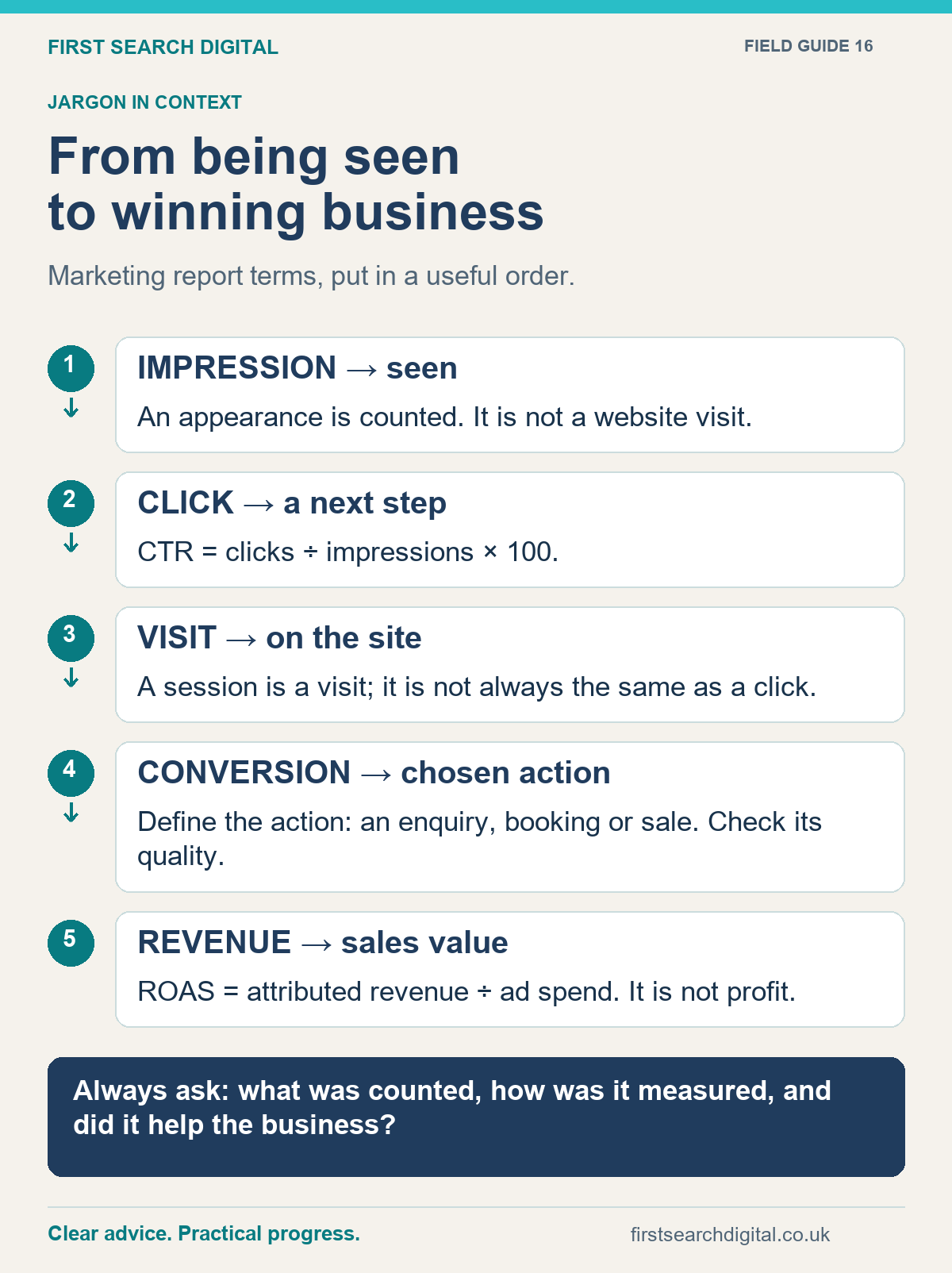
Text version of the infographic: From being seen to winning business
From being seen to winning business
Marketing report terms, put in a useful order.
IMPRESSION → seen — An appearance is counted. It is not a website visit.
CLICK → a next step — CTR = clicks ÷ impressions × 100.
VISIT → on the site — A session is a visit; it is not always the same as a click.
CONVERSION → chosen action — Define the action: an enquiry, booking or sale. Check its quality.
REVENUE → sales value — ROAS = attributed revenue ÷ ad spend. It is not profit.
Always ask: what was counted, how was it measured, and did it help the business?
One example that separates the numbers
Imagine a hypothetical campaign with 10,000 impressions, 200 clicks, £400 in advertising spend and ten genuine enquiries. Two enquiries become customers, each buying £500 of work.
- CTR is 200 ÷ 10,000 × 100 = 2%.
- Average CPC is £400 ÷ 200 = £2.
- Enquiry conversion rate per click is 10 ÷ 200 × 100 = 5%.
- Ad-spend-only CPL is £400 ÷ 10 = £40.
- Ad-spend-only cost per customer is £400 ÷ 2 = £200.
- If all £1,000 of sales is attributed to those ads, ROAS is £1,000 ÷ £400 = 2.5 times, or 250%.
Now suppose delivering that work costs £300 and campaign management costs £100, with no other costs in this simplified example. The £1,000 revenue leaves £200 after the £300 delivery cost, £400 ads and £100 management. If marketing ROI is defined as that £200 incremental profit divided by the £500 marketing investment, it is 40%. The result depends on those assumptions, including whether the sales were genuinely additional.
That is why a healthy-looking ROAS and a worthwhile business result are not interchangeable.
You can always ask for the plain-English version
The useful follow-up to any unfamiliar term is: “What does that mean we should do, and why?” A good explanation should connect the proposed work with your customers, available budget and business priorities.
The free website and SEO health check can help you connect these terms with practical questions about your own website.
Put this into practice
To see several of these terms on a real page, try PageSweep. It puts explanations beside page titles, descriptions, indexing instructions, headings and links.