White hat, grey hat and black hat are labels people use to describe how they approach SEO. Evergreen describes how long content remains useful. They answer different questions, which is why treating them as four competing SEO strategies can be confusing.
For a small business, the decision should be practical: what work is being done, who benefits, what risk does it introduce and will it still make sense after the next sales pitch or platform update?
The difference in a few sentences
- White hat SEO: work intended to help users and improve search visibility within search engine guidance.
- Grey hat SEO: an informal label for practices someone considers borderline or is reluctant to describe as clearly compliant.
- Black hat SEO: deliberate attempts to manipulate search results using practices that violate search engine policies.
- Evergreen content: material that continues to answer a recurring need, although its details may need maintenance.
The hat labels are industry shorthand, not Google certifications. Ask about the actual method rather than accepting the label as proof.
What white hat SEO looks like in everyday work
For a local business, I would start by making the website clearer and more useful. Can someone understand the services, the area you cover, why they should trust you and how to get in touch? Can search engines access the important pages?
The work might include improving a confusing service page, fixing an accidental indexing restriction, organising internal links, adding original project examples or answering a question customers repeatedly ask.
This approach fits the principles in Google Search Essentials: useful content, accessible pages and clear information. Meeting the guidance does not guarantee that a page will be indexed or rank in a particular position.
White hat does not mean passive. Research, technical improvements and active promotion can require considerable effort. It also does not mean every piece of work produces an immediate return. You still need to choose commercially relevant priorities and review whether they help.
Why “grey hat” is not a safety guarantee
There is no universally agreed boundary for grey hat SEO. One person may use the term for an experimental but legitimate approach. Another may use it to make a link scheme sound less concerning.
That ambiguity makes the phrase a poor basis for a business decision. If a supplier says something is grey hat, ask them to describe the process in ordinary language, including what they buy, what they control and what they will publish in your name.
For example, a genuine article on a relevant publication can be useful. A paid placement sold chiefly as a way to pass ranking credit is a different proposition. The broad label “guest posting” does not tell you which arrangement you are buying.
Paid sponsorship can be legitimate when handled transparently. Google provides specific guidance for identifying sponsored and other outbound links. It is more useful to examine that guidance and the actual arrangement than to debate which colour hat someone prefers.
What black hat SEO means
Examples of policy-violating practices include cloaking, hidden text intended to manipulate rankings, link spam and creating large amounts of low-value content primarily to manipulate search. Google’s spam policies explain these practices and the possibility of lower rankings or exclusion from results.
A temporary improvement would not establish that a method is safe. Nor does a competitor apparently using it tell you what is happening inside their business, which links Google is ignoring or whether their results will last.
For an established business, I would weigh the possible downside against the value of the website, reputation and customer relationships you already have. Recovering from an avoidable problem can cost more attention and money than the original shortcut appeared to save.
Does adding layers make link building safer?
Tiered link building means creating links to pages that themselves link to your website. A second layer points to the first, and sometimes a third layer is added.
The presence of layers alone says little about quality. An ordinary web can naturally contain several hops between useful resources. A manufactured network whose purpose is to manipulate rankings deserves a different assessment.
I would not accept “the spam is only in tier two” as a safety explanation. Ask who owns each layer, why those pages exist, whether anyone reads them and which parts of the plan depend on concealing how the links were obtained.
Likewise, a higher DA or DR is not evidence that this is a sound investment. Those are third-party metrics. Ahrefs explains the distinction in its guide to Domain Rating and ranking factors.
Evergreen content answers a different question
An evergreen article serves a need that does not disappear when this week’s news changes. For a service business, that might be a guide to preparing for a quotation, choosing between two services, caring for a finished installation or understanding a common problem.
A page announcing next Saturday’s event is time-sensitive. A guide to planning an accessible event may remain useful for years. Both can be worthwhile; they serve different needs.
Evergreen content is not automatically accurate or ethical. An enduring topic can still be handled badly, stuffed with keywords or filled with unsupported claims. Conversely, a timely news article can be carefully researched and entirely appropriate.
Evergreen does not mean publish and forget
A guide to asking for Google reviews may address a lasting need while its screenshots, button names and policy advice become outdated. A jargon guide can still be useful while the products and bidding strategies it describes change.
Give useful pages a review date. Check examples, links, screenshots, prices and any instructions involving a platform. Update the substance when needed, and explain material changes rather than simply changing the year in the title.
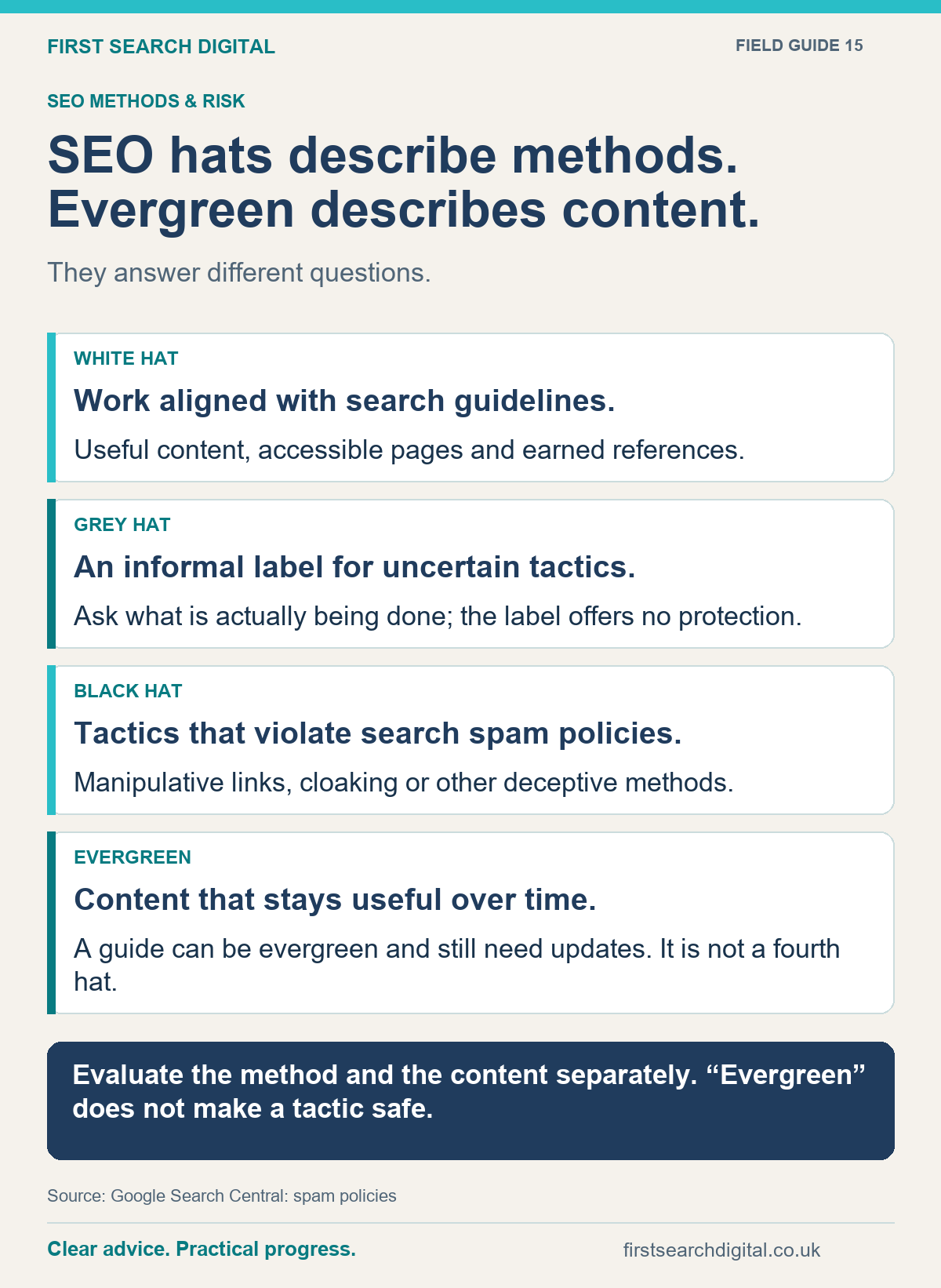
Text version of the infographic: SEO hats describe methods. Evergreen describes content.
SEO hats describe methods. Evergreen describes content.
They answer different questions.
WHITE HAT — Work aligned with search guidelines. — Useful content, accessible pages and earned references.
GREY HAT — An informal label for uncertain tactics. — Ask what is actually being done; the label offers no protection.
BLACK HAT — Tactics that violate search spam policies. — Manipulative links, cloaking or other deceptive methods.
EVERGREEN — Content that stays useful over time. — A guide can be evergreen and still need updates. It is not a fourth hat.
Evaluate the method and the content separately. “Evergreen” does not make a tactic safe.
Sources: Google Search Central: spam policies.
Where AI-generated content fits
Using AI does not automatically put content into a particular hat category. The questions are what the work is for and whether it is useful, accurate and properly reviewed.
Google’s guidance on generative AI content recognises useful applications, while warning about generating many pages without adding value.
My preference is to start with the business’s knowledge: the questions clients ask, the choices they struggle with and the details only someone doing the work would know. A tool can help organise that material. It should not invent experience, customer results or evidence.
A useful way to assess any proposed tactic
- Describe it: can the supplier explain the work without hiding behind terminology?
- Identify the benefit: how does it help the right customer or improve a real part of the website?
- Check the evidence: what supports the claim, and which assumptions remain uncertain?
- Understand the risk: what might go wrong, and who would do the recovery work?
- Agree the measure: will you review useful visibility and enquiries, rather than only a score?
- Plan maintenance: what needs checking once the initial work is finished?
For most small businesses I work with, the sensible foundation is useful service information, a dependable website, genuine evidence of the work and a manageable plan for improvement. Evergreen resources can support that foundation when they answer questions your customers actually have.
That is the approach behind my SEO and local search support. If a proposal contains a tactic you are unsure about, send me the details and we can discuss what it means for your business.
Put this into practice
Use PageSweep to inspect visible page details such as titles, indexing instructions, headings and links. Treat its findings as questions to investigate, not a verdict on whether a whole SEO campaign is compliant.