Yes, social media can be worth doing—even when it is not your main source of enquiries. Its role may be to help someone trust your business after they have found you somewhere else. But that does not mean every company needs to post daily, chase followers or maintain five platforms.
I get asked this question regularly. My answer starts with what social media needs to do for the business: introduce you to people, reassure someone checking you out, maintain relationships or support a specific campaign.
Those are different jobs. You need to choose the relevant one before deciding how much time or money to invest.
Customers may check you before they contact you
Imagine someone receives a recommendation for a local business. They visit the website, then open its social profile to see recent work, the people involved and how it communicates.
A useful profile can help answer questions such as “Are they still active?”, “Do they do the kind of work I need?” and “Would I feel comfortable contacting them?” That hypothetical customer might eventually enquire by email and say they came through a friend. Social media helped reassure them without receiving credit as the original source.
This is why judging every post only by immediate clicks can miss part of its role. It is also why “brand awareness” should not become an excuse for activity that nobody evaluates.
What I mean by trust and brand signals
I mean visible evidence that helps people recognise and assess the business: consistent details, a recognisable identity, real work, useful answers and professional responses.
A photograph of a completed job with a clear explanation can tell a prospective customer more than a generic motivational quote. Showing the person doing the work can make an unfamiliar business feel more understandable. Answering a genuine question can demonstrate how you communicate.
These are practical signals to people, not a claim that a particular number of likes increases Google rankings. Google’s SEO Starter Guide includes social promotion as a way to help people discover content. That does not establish a guaranteed ranking benefit from posting frequency, follower totals or engagement.
When social media may deserve more investment
It can be a strong fit when your work is easy to demonstrate, customers need familiarity before buying, there are useful questions to answer or your audience already participates on a particular platform.
A visual business might show the process and finished work. A consultant might explain a common decision clearly. A local organisation might use updates to keep people informed about what is happening and how to take part.
These are possibilities to test, not guarantees about any sector. Ask existing customers which platforms they use to research providers and what information they would find helpful there.
When a modest presence is enough
Some businesses mainly win work through referrals, repeat customers or searches made at the moment of need. Social media can then be a supporting reference point rather than an intensive publishing operation.
My suggested minimum is a complete profile with an accurate description, website link, service area where relevant and a small body of useful evidence. Keep essential information current, make clear how enquiries are handled and check messages often enough to meet the expectation you create.
If you cannot reliably monitor direct messages, say where customers should contact you. Do not invite urgent requests into an inbox nobody reads.
An old post is not automatically a commercial disaster. A contradictory offer, unanswered enquiry or misleading opening time is a more concrete problem.
Choose one platform for a reason
Start where there is a plausible connection between your customers, the type of information you can produce and the way they make decisions. You do not need an account everywhere just because a competitor has one.
Look at the content you can sustain. If your best material is short explanations and photographs, build around that rather than committing to elaborate videos you cannot maintain.
Remember that a platform controls its own distribution and account rules. Keep important information on your website too, and retain original photographs and copy so they remain useful beyond one channel.
What should a small business post?
- Evidence of real work: what was needed, what you did and what the customer should understand, with permission where necessary.
- Answers to genuine questions: explain a choice, process or common misunderstanding.
- The people and approach: show who customers will deal with and how work is handled.
- Useful updates: actual availability, service changes or relevant news.
- A clear invitation: tell people how to take the next step when the post supports it.
Do not invent testimonials or results. Check permissions before showing customers, private locations or identifiable information. Make posts readable, add useful image descriptions where supported and caption videos so the message does not depend on sound.
Separate organic activity from paid advertising
Maintaining a useful profile and running paid social campaigns are different commitments. Paying to distribute a post does not repair an unclear offer or guarantee suitable enquiries.
For advertising, agree the audience, objective, creative material, destination, measurement and budget first. Record advertising spend separately from the time spent creating and managing it. My social advertising service covers that more deliberate campaign work.
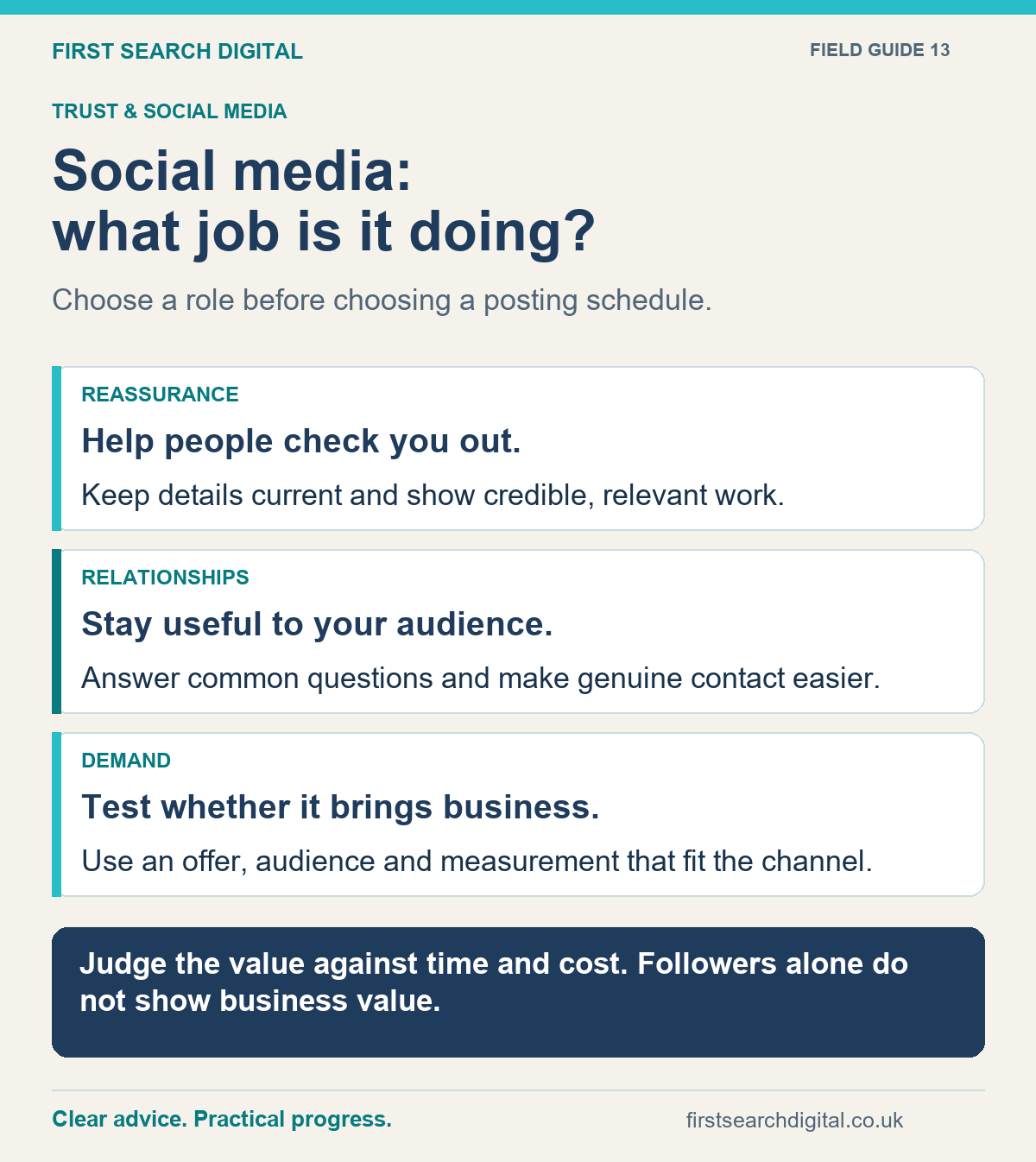
Text version of the infographic: Social media: what job is it doing?
Social media: what job is it doing?
Choose a role before choosing a posting schedule.
REASSURANCE — Help people check you out. — Keep details current and show credible, relevant work.
RELATIONSHIPS — Stay useful to your audience. — Answer common questions and make genuine contact easier.
DEMAND — Test whether it brings business. — Use an offer, audience and measurement that fit the channel.
Judge the value against time and cost. Followers alone do not show business value.
Run a manageable test and review it honestly
For example, choose an eight-week test with a fixed weekly time allowance, one platform and a small set of content themes. That is a planning example, not a universal posting schedule or a guarantee that eight weeks will prove commercial value.
Record the time spent, relevant conversations, useful website visits where measurable and enquiries that mention the activity. Ask new customers both how they first heard of you and what they checked before contacting you.
Likes and reach can help diagnose distribution, but they are not customers. Equally, a lack of direct enquiries does not prove zero reassurance value. Make the uncertainty explicit and decide whether the modest supporting benefit justifies the ongoing cost.
So, is it worth it?
For many small businesses, a credible, maintained presence is a sensible starting point. A large ongoing content commitment needs a stronger case based on your audience, capacity and results.
Social media should fit alongside the website, search, referrals and the way you respond to people. At the beginning of the month, we can agree where the available budget and time are most useful rather than assuming one channel always gets the same allocation.
Explore flexible monthly support or training to manage more yourself. If you are unsure whether to maintain, expand or reduce your social activity, tell me how customers currently find and choose your business.
Put this into practice
Use the Website & SEO Health Check to review the trust signals and customer journey behind your social presence. It is a guided self-assessment, rather than an automated social media audit.